For a mid-market business, losing recoverable GST rarely comes down to one dramatic mistake. More often, value slips away through everyday gaps: an employee uploads an incomplete receipt, a tax invoice is addressed incorrectly, a mixed personal-and-business expense is reimbursed without proper review, or finance discovers missing documentation only during month-end close.
For Singapore-based finance teams, these gaps matter. Singapore’s prevailing GST rate is 9%, and GST-registered businesses may claim qualifying GST incurred on business purchases as input tax only when the relevant conditions are met. Reimbursing an employee does not, by itself, make the GST automatically recoverable.
This guide explains how Singapore GST expense recovery works in practice, where employee expenses create risk, and how finance teams can build a cleaner process for capturing eligible input tax without treating every receipt as automatically claimable.
What Is Singapore GST Expense Recovery?
In practical terms, Singapore GST expense recovery refers to claiming eligible input tax, the GST incurred on qualifying business purchases and expenses, through the GST reporting process.
Consider a simple example. A GST-registered company purchases qualifying goods or services for its business and incurs GST on that purchase. If the conditions for claiming input tax are satisfied and the GST is not specifically blocked, the business may be able to claim that input tax.
However, the presence of “9% GST” on a document is not enough on its own. According to Inland Revenue Authority of Singapore guidance, the business must satisfy applicable input-tax conditions. These include being GST-registered, having goods or services supplied to or imported by the business, and using or intending to use them for business purposes, alongside the other relevant requirements.
That distinction is essential for finance teams:
GST paid is not always GST recoverable.
A strong expense recovery process therefore needs to answer several questions before a claim is treated as recoverable:
- Is the company GST-registered?
- Was the purchase genuinely for business purposes?
- Does the business have appropriate supporting documentation?
- Is the expense linked to taxable business activities?
- Is the input tax specifically disallowed or restricted?
- If an employee paid personally, can the company support the basis for claiming the GST?
The recovery decision depends on the underlying transaction and evidence, not simply on whether the employee was reimbursed.
Why GST Expense Recovery Matters More at Mid-Market Scale
A small team may be able to investigate questionable receipts individually. A business with 50 to 300 employees faces a different operational problem.
Finance may be processing expenses from sales teams, consultants, executives, project managers, and regional employees. Claims can arrive from multiple merchants and in different formats, including:
- Restaurant receipts
- Hotel bills
- Taxi and ride-hailing receipts
- Software purchases
- Mobile and telecommunications bills
- Office supplies
- Professional services
- Employee-paid business purchases
At this volume, small process weaknesses repeat.
Suppose an organisation misses just S$9 of otherwise recoverable GST across 100 qualifying transactions because documentation is incomplete or claims are processed inconsistently. That represents S$900 in potential recovery affected by process gaps. The example is illustrative, but the operational point is straightforward: small losses become material when repeated across a growing expense base.
The reverse risk matters too. A company that claims input tax without satisfying the applicable conditions can create compliance exposure.
For finance leaders, the objective is therefore not to maximise claims at any cost. It is to build a process that identifies eligible GST accurately, preserves evidence, and prevents unsupported claims.
The Core Conditions Finance Teams Should Check
Before treating GST on an expense as recoverable, finance teams should apply a consistent review framework.
1. Confirm the Business Is GST-Registered
Input tax recovery starts with GST registration. A business cannot simply treat GST on purchases as recoverable because suppliers charged GST.
This sounds basic, but it becomes relevant in group structures where multiple entities operate under different registration positions.
Finance teams should ensure the entity making the claim is the appropriate GST-registered business and that the transaction is recorded against the correct entity.
2. Establish a Genuine Business Purpose
The goods or services should be used, or intended to be used, for the purposes of the business under the applicable input-tax rules.
For employee expenses, a clear business purpose can make the review process significantly easier.
Lets Compare:
Dinner – S$218
with:
Client dinner with ABC Pte Ltd project team following implementation meeting – S$218
The second description gives the reviewer meaningful context. It does not automatically establish recoverability, but it creates a stronger record for assessing the claim.
A practical expense workflow should therefore capture the business purpose at submission, not weeks later when finance begins reconciliation.
3. Check the Supporting Document
Documentation is central to input tax claims. IRAS guidance states that input tax claims must be supported by the relevant valid tax invoices or simplified tax invoices, as applicable.
Finance teams should not treat every uploaded image as sufficient evidence merely because it looks like a receipt.
The review process should check whether the documentation is appropriate for the transaction and supports the amount being claimed.
Common problems include:
- Blurry receipt images
- Cropped totals
- Missing supplier information
- Duplicate uploads
- Card slips submitted instead of the relevant receipt or invoice
- Documents belonging to another transaction
- Incomplete invoice details
4. Check Whether the Expense Is Blocked or Restricted
Not all GST incurred by a business is recoverable.
Certain expenses may be subject to specific restrictions or disallowance. Finance teams should therefore avoid a simplistic rule such as:
“Business expense + GST = claimable input tax.”
The correct treatment depends on the nature of the expense and the applicable GST rules. IRAS guidance on input-tax claims and GST returns specifically identifies categories requiring careful treatment.
For borderline or material items, finance teams should refer to current official guidance and obtain professional tax advice where appropriate.
Employee Expenses: Where Recovery Gets Complicated
Employee-paid expenses are one of the most important areas for a practical Singapore GST expense recovery process.
An employee may pay personally for a legitimate business cost and later request reimbursement. But the fact that the company repays the employee does not automatically settle the input-tax question.
IRAS provides specific guidance for expenses incurred by an employee on behalf of a company. In one example involving an employee’s personal mobile phone bill containing both private and business calls, the bill must be separated between private and business expenses; GST on private calls is not claimable, while GST on business calls may be claimable if the company can prove that the employee acted as its agent.
That example highlights two practical principles:
- Separate private and business use
- Preserve evidence supporting the employee’s role on behalf of the company
For finance teams, this means an expense workflow should capture more than the reimbursement amount.
Useful information may include:
- Employee name
- Transaction date
- Merchant
- Business purpose
- Expense category
- GST amount
- Receipt or invoice
- Project or cost centre
- Approver
- Explanation for mixed-use expenses
Without this context, finance may know what it reimbursed but still lack enough information to assess the GST treatment confidently.
A Practical GST Recovery Workflow for Employee Expenses
Mid-market finance teams can reduce inconsistency by applying the same workflow to every expense.
| Stage | Finance Check | Common Risk |
| Submission | Receipt and business purpose captured | Missing evidence |
| Extraction | Merchant, date, amount and GST recorded | Manual entry errors |
| Validation | Document checked against claim | Wrong or duplicate receipt |
| GST review | Eligibility assessed | Assuming all GST is recoverable |
| Approval | Correct manager reviews claim | Inconsistent exceptions |
| Accounting | Expense and tax treatment recorded | Incorrect coding |
| Retention | Evidence stored for retrieval | Audit trail gaps |
Step 1: Capture the Expense Promptly
Employees should submit expenses as close to the transaction date as possible.
Waiting until month-end increases the likelihood of lost receipts, forgotten business purposes, and incomplete explanations.
Step 2: Capture the Tax Information
Finance needs visibility into the relevant values on the supporting document rather than only the gross amount paid.
Depending on the transaction, this may include:
- Pre-GST amount
- GST amount
- Total
- Supplier details
- Transaction date
Step 3: Validate the Claim
The expense should be checked for:
- Business purpose
- Policy compliance
- Supporting documentation
- Duplicate submission
- Correct entity
- Appropriate approval
Step 4: Assess GST Recoverability Separately
An expense can be valid for employee reimbursement without necessarily producing a recoverable input-tax claim.
This distinction is crucial.
For example, finance may decide that an employee should be reimbursed under company policy while still determining that the GST should not be claimed because the input-tax conditions are not satisfied.
Step 5: Preserve the Audit Trail
The final record should make it possible to understand:
- What was purchased
- Why it was purchased
- Who incurred the expense
- Who approved it
- What evidence supported it
- How the GST was treated
This creates a cleaner process for reconciliation, internal review, and audit preparation.
Common Reasons Businesses Miss Recoverable GST
Mid-market organisations often focus on tax rates while overlooking the operational problems that affect recovery.
Missing Receipts and Invoices
An employee submits the expense but cannot provide adequate supporting documentation. Finance reimburses the claim but may face difficulty supporting an input-tax claim.
Late Submissions
When employees submit expenses weeks later, documents are more likely to be missing and business context is harder to reconstruct.
Incorrect Expense Coding
A valid business purchase may be recorded under the wrong category or tax treatment, creating additional reconciliation work.
Mixed Personal and Business Expenses
Where a cost contains both private and business elements, treating the full amount as a business expense can create problems. The relevant components need to be identified and handled appropriately.
Assuming Every GST Amount Is Recoverable
This is one of the most dangerous shortcuts. The 9% rate tells you the prevailing GST rate for standard-rated supplies; it does not establish that every amount of GST paid is recoverable by the business.
Fragmented Expense Channels
Receipts arrive through email, messaging apps, spreadsheets, and paper forms. Finance then has to reconstruct the evidence during reconciliation.
The result is not merely slower reimbursement. It can weaken the quality of the data used to assess GST recovery.
A Practical GST Expense Recovery Checklist
A good Singapore GST expense recovery process should make the correct treatment easier at the point of submission, not depend on finance reconstructing every transaction at quarter-end.
For each expense, finance teams can work through a practical checklist:
- Is the claiming entity GST-registered?
- Was the expense incurred for a genuine business purpose?
- Is the purchase linked to the business activities relevant to the input-tax claim?
- Is there a valid tax invoice or applicable simplified tax invoice?
- Does the document match the submitted amount, date, and merchant?
- Is the expense wholly business-related, or does it contain a private element?
- Is the input tax subject to a specific restriction or disallowance?
- For an employee-paid expense, is there sufficient evidence supporting the company’s basis for the claim?
- Has the same receipt or invoice already been submitted?
- Is the GST being claimed in the correct accounting period?
This checklist should not be treated as a substitute for transaction-specific tax analysis. Its purpose is to catch common operational gaps before they reach the GST return.
Current Inland Revenue Authority of Singapore guidance states that businesses should claim input tax only when the relevant conditions are satisfied and in the appropriate accounting period.
Build GST Controls into the Expense Policy
Many GST problems begin before finance sees the claim.
If employees are not told what documentation to collect, when to submit it, or how to describe the business purpose, finance inherits an incomplete record. A well-designed expense policy can reduce this problem by making GST-relevant requirements part of the normal reimbursement process.
Define Acceptable Supporting Documents
The policy should explain what employees need to submit for different expense types.
For example, finance teams may distinguish between:
- A valid tax invoice
- A simplified tax invoice where applicable
- A standard merchant receipt
- A card payment slip
- A booking confirmation
- A screenshot without sufficient transaction detail
These documents do not necessarily provide the same support for an input-tax claim. IRAS notes that input tax claimed must be supported by the applicable valid tax invoices or simplified tax invoices, and tax invoices are a key document supporting input-tax claims.
Require a Clear Business Purpose
A category such as “meals” or “transport” tells finance what was purchased, but not why the company incurred the cost.
Require employees to add enough context for meaningful review.
For example:
Weak description:
Taxi – S$34
Better description:
Taxi from office to client implementation meeting – S$34
The second description gives finance and approvers a clearer basis for assessing the business purpose.
Set Submission Deadlines
A policy should define how soon employees are expected to submit expenses.
Prompt submission helps reduce:
- Lost receipts
- Faded thermal receipts
- Forgotten business purposes
- Missing attendee information
- Quarter-end reconciliation pressure
The exact deadline should fit the organisation’s operating model. What matters is that the rule is clear and consistently applied.
Define How Mixed-Use Expenses Are Handled
Some expenses contain both business and private elements.
Personal mobile phone bills used partly for business are a useful example. IRAS guidance specifically discusses separating private and business expenses and the conditions relevant to a company’s input-tax claim where an employee incurs costs on the company’s behalf.
Your policy should explain when employees must identify the business portion and what evidence finance requires.
Document Exception Handling
Not every legitimate business expense will fit neatly into standard rules.
The policy should state:
- Who can approve an exception
- What explanation is required
- Whether additional documentation is needed
- How finance records the exception
This prevents “manager approved it” from becoming a substitute for appropriate GST review.
Do Not Confuse Reimbursement Approval with GST Recoverability
This distinction deserves its own section because it is easy to miss.
An expense can be:
- Valid for reimbursement and potentially GST-recoverable
- Valid for reimbursement but not GST-recoverable
- Not valid under company policy
These are different decisions.
Consider an employee who incurs a cost that the company agrees to reimburse. Finance should not automatically conclude that any GST shown is claimable as input tax. The relevant input-tax conditions, documentation, business purpose, and restrictions still need to be considered.
A mature workflow therefore separates:
“Should we reimburse the employee?”
from:
“Can the company claim this GST as input tax?”
That separation reduces the risk of using reimbursement policy as a proxy for tax treatment.
Common Policy Gaps That Reduce Recovery Quality
Even detailed policies can fail when they do not reflect how employees actually spend.
One Rule for Every Expense Category
A hotel invoice, taxi receipt, mobile phone bill, and client meal can raise different documentation and review questions.
A policy that simply says “attach receipts for all expenses” may be too broad to guide employees effectively.
No Guidance for Employee-Paid Purchases
If employees regularly buy items on behalf of the company, the policy should explain what evidence they need to retain and how the purchase should be documented.
No Process for Missing Documents
Finance teams need a consistent response when an employee cannot provide the expected documentation.
Without one, exceptions are handled differently across departments.
No Distinction Between Gross Expense and GST Treatment
Expense systems and spreadsheets sometimes capture only the total amount.
That makes it harder to review the tax component separately and can increase reconciliation work.
Policy Rules That Exist Only in a PDF
A policy can be technically complete and still fail operationally.
If employees must remember every rule themselves, finance will continue receiving incomplete claims. The strongest processes reinforce policy requirements during submission and approval.
How Automation Can Improve GST Expense Capture
Automation does not decide tax treatment by magic, and finance teams should be cautious of any system that implies otherwise.
Its real value is more practical: better data capture, earlier validation, and a more consistent audit trail.
Capture Receipts Earlier
When employees submit receipts soon after a purchase, there is less opportunity for documents to disappear.
This also makes it easier to capture the business purpose while the transaction is still fresh.
Reduce Manual Data Entry
Receipt-processing technology can help extract fields such as:
- Merchant
- Transaction date
- Total
- Tax amount
- Currency
Finance can then review the captured information rather than retyping every field manually.
Flag Missing Information Before Approval
A structured workflow can identify claims missing required fields, such as:
- Receipt
- Business purpose
- Cost centre
- Project code
- Approver
This moves correction earlier in the process.
Maintain a Searchable Audit Trail
Digital records make it easier to connect:
- The expense claim
- Supporting document
- Employee explanation
- Approval history
- Accounting treatment
That matters because GST-registered businesses must keep proper business and accounting records for at least five years to support GST declarations.
A 2026 Consideration: Singapore’s GST InvoiceNow Expansion
Finance teams should also pay attention to Singapore’s broader shift towards structured digital invoice data.
From 1 April 2026, businesses applying for voluntary GST registration are required to submit invoice data to IRAS through the InvoiceNow network. IRAS has also announced a phased expansion of the requirement to additional GST-registered businesses over time.
This does not mean every employee receipt automatically flows through InvoiceNow, nor does it remove the need to assess input-tax eligibility. But it reinforces a broader operational direction: finance data is becoming more structured, connected, and digitally reportable.
For mid-market businesses, that makes fragmented receipt handling increasingly difficult to justify. Expense workflows, invoice processes, accounting systems, and tax controls should be designed to produce reliable data rather than require manual reconstruction at filing time.
Managing Expense Policies Across Multiple Countries
A Singapore-based company may also have employees in India, Australia, the UAE, the UK, or elsewhere in Southeast Asia.
That creates a policy challenge. A global expense framework may define common principles, but local tax treatment can differ significantly.
For example, organisations may need to account for differences in:
- GST or VAT rates
- Invoice requirements
- Recoverability rules
- Local terminology
- Mileage reimbursement practices
- Record-keeping obligations
- Currency
- Approval thresholds
The practical answer is usually not to create completely disconnected policies for every office. Instead, finance and HR teams can establish:
A global policy core, covering principles such as business purpose, approvals, fraud prevention, submission deadlines, and documentation.
Local schedules or addenda, covering country-specific tax rules, limits, and compliance requirements.
For organisations managing employees across several markets, the Multi-Country Policy resource can provide a useful starting point for structuring those differences without losing global consistency.
How REME Can Support a Cleaner Expense Process
GST recovery depends on the quality of information captured throughout the expense workflow.
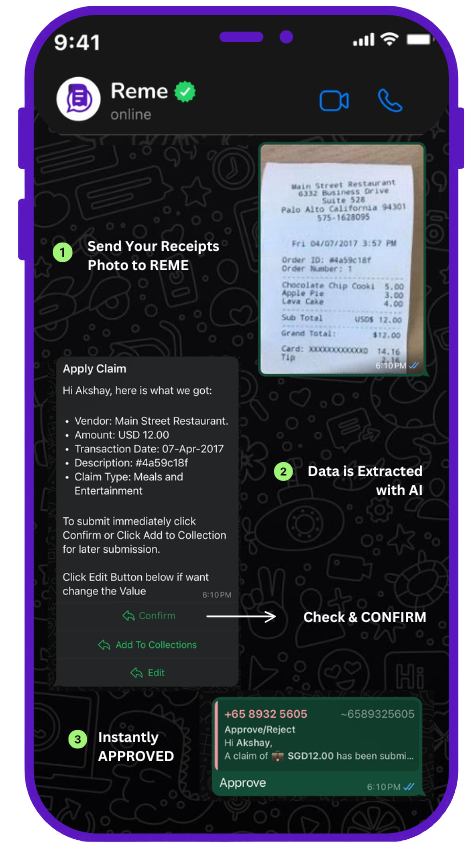
REME is a WhatsApp-native expense management platform designed to help finance teams simplify how employees submit and manage business expenses. Employees can submit receipts through WhatsApp, reducing the friction of waiting until month-end or switching between multiple systems.
For finance teams, a more structured process can help improve:
- Receipt capture
- Expense documentation
- Approval routing
- Visibility into submitted claims
- Record organisation
- Follow-up on incomplete expenses
The important distinction is that expense automation supports the process around GST recovery; it does not make every GST amount claimable. Final tax treatment still depends on the facts of the transaction and applicable IRAS rules.
That is exactly why good workflow design matters. The aim is to give finance teams cleaner information earlier, so they can make better-supported decisions instead of chasing evidence after the fact.
Turn GST Requirements into a Policy Employees Can Follow
A finance team can understand Singapore GST rules perfectly and still struggle if employees do not know what to submit.
That is where policy design becomes operationally important.
A practical expense policy can specify:
- Which documents employees should retain
- When claims must be submitted
- What counts as an adequate business purpose
- How mixed personal and business expenses are handled
- Which claims need additional approval
- What happens when documents are missing
- How local requirements differ across countries
Rather than building these rules from a blank page, use REME’s Expense Policy Generator as a starting point for creating a clearer, more consistent expense framework.
Create an expense policy with REME’s generator
Frequently Asked Questions
What is Singapore GST expense recovery?
Singapore GST expense recovery generally refers to a GST-registered business claiming eligible GST incurred on qualifying business purchases and expenses as input tax. The relevant IRAS conditions must be satisfied, and specific restrictions can apply.
Is Singapore GST still 9% in 2026?
Yes. Singapore’s prevailing GST rate is 9% in 2026. The rate increased from 8% to 9% on 1 January 2024.
Can a company claim GST on every employee expense?
No. Reimbursing an employee does not automatically make GST recoverable. Finance teams must consider the business purpose, supporting evidence, applicable input-tax conditions, and whether the expense is restricted or disallowed. Employee-incurred expenses can also require evidence that the employee acted on behalf of the company.
Can GST be claimed without a receipt or tax invoice?
Finance teams should not assume so. IRAS states that input tax claims must be supported by the applicable valid tax invoices or simplified tax invoices. The exact documentary requirement depends on the transaction and circumstances.
How long should GST records be kept in Singapore?
GST-registered businesses must keep proper business and accounting records for at least five years to support GST declarations.
Does expense management software guarantee GST recovery?
No. Software can improve receipt capture, workflow consistency, and record organisation, but GST recoverability depends on the underlying transaction and applicable tax rules.
Conclusion
At a 9% GST rate, expense recovery deserves more than an end-of-quarter check. For mid-market businesses, the quality of the claim often depends on decisions made much earlier: whether the employee captured the right document, explained the business purpose, separated private use, and submitted the expense through a process finance can audit.
The strongest approach is not to claim every visible GST amount. It is to create a repeatable system for identifying eligible input tax, rejecting unsupported treatment, and preserving the evidence behind each decision.
That requires coordination between tax, finance, HR, managers, and employees. A clear policy defines expectations; a structured workflow reinforces them; and regular review helps prevent small process gaps from becoming recurring losses or compliance risks.
For current transaction-specific rules, finance teams should always refer to IRAS guidance on claiming input tax and obtain professional advice where appropriate.
Ready to make expense requirements clearer for employees across Singapore and other markets? Use REME’s Expense Policy Generator to create a practical policy framework for submissions, documentation, approvals, and exceptions, then adapt it to your organisation’s local tax requirements.