Expense management is the process of tracking, approving, reimbursing, and analysing business expenses while ensuring compliance with company policies. An effective expense management system helps finance teams reduce manual work, improve visibility into company spending, accelerate reimbursements, and minimise fraud. As organisations grow, automating expense management becomes essential for maintaining financial control and operational efficiency.
What Is Expense Management?
Every business spends money to keep operations running. Employees travel to meet clients, purchase office supplies, pay for software subscriptions, entertain customers, and attend conferences. While these expenses support business growth, they also need to be tracked, verified, and reimbursed accurately.
This is where expense management comes in.
Expense management is the process of recording, reviewing, approving, reimbursing, and monitoring business-related expenses. It ensures employees are reimbursed for legitimate business costs while giving finance teams complete visibility into organisational spending.
An effective expense management process doesn’t just focus on paying employees back. It also helps businesses maintain policy compliance, reduce unnecessary spending, simplify audits, and make informed financial decisions.
Whether you’re managing a team of 50 employees or several hundred across multiple locations, having a structured expense management process is essential for maintaining financial discipline.
Why Expense Management Matters
Without a defined expense management process, even routine reimbursements can become time-consuming and difficult to control.
Consider a typical scenario. An employee completes a business trip, collects paper receipts, fills out a spreadsheet, emails it to their manager, waits for approval, and then follows up with finance to check the reimbursement status.
Now multiply this process across dozens or even hundreds of employees every month.
The result is often:
- Delayed reimbursements
- Lost or incomplete receipts
- Manual data entry
- Approval bottlenecks
- Policy violations
- Limited visibility into company spending
An organised expense management process helps eliminate these challenges by creating a consistent workflow for employees, managers, and finance teams.
How Does Expense Management Work?
Although every organisation has its own policies, the expense management process generally follows six key steps.
1. Expense Submission
Employees submit their business expenses along with supporting documents such as receipts, invoices, or travel confirmations.
Modern expense management platforms allow employees to submit expenses digitally, making it easier to capture information while the purchase is still fresh.
2. Expense Verification
Finance teams review submitted expenses to confirm that:
- The expense is business-related.
- Supporting documents are attached.
- The amount matches the receipt.
- The claim complies with company policy.
This step helps prevent duplicate submissions, incorrect reimbursements, and policy violations.
3. Approval Workflow
Depending on the expense amount or category, claims are routed to the appropriate manager for approval.
Automated approval workflows reduce unnecessary delays by ensuring every claim reaches the right decision-maker without manual follow-ups.
4. Reimbursement
Once approved, the expense is reimbursed through payroll or the organisation’s preferred payment process.
A streamlined reimbursement process improves employee satisfaction by ensuring legitimate claims are paid promptly.
5. Expense Recording
Approved expenses are recorded in the company’s accounting system.
Accurate record-keeping supports budgeting, financial reporting, and compliance with internal and external audit requirements.
6. Reporting and Analysis
Expense management doesn’t end with reimbursement.
Finance teams analyse spending trends to answer questions such as:
- Which departments spend the most?
- Are travel expenses increasing?
- Which vendors receive the highest payments?
- Are employees consistently following company policies?
These insights help organisations identify cost-saving opportunities and make more informed financial decisions.
Common Challenges of Manual Expense Management
Many businesses still rely on spreadsheets, email approvals, and paper receipts to manage expenses. While this approach may work for smaller teams, it becomes increasingly difficult as organisations grow.
Here are some of the most common challenges.
Time-Consuming Administrative Work
Finance teams often spend hours reviewing receipts, entering data manually, and following up on incomplete expense claims.
Instead of focusing on budgeting, forecasting, or financial planning, valuable time is spent on repetitive administrative tasks.
Delayed Reimbursements
When approvals depend on multiple emails or paper-based processes, reimbursements can take weeks.
Delays not only frustrate employees but also create additional follow-up work for finance teams.
Limited Visibility into Spending
Without centralised expense data, it’s difficult to understand where company money is being spent.
Finance managers may only identify overspending after month-end reporting, leaving little opportunity to control costs in real time.
Higher Risk of Errors
Manual processes increase the likelihood of:
- Duplicate expense claims
- Missing receipts
- Incorrect reimbursement amounts
- Data entry mistakes
Even small errors can affect financial reporting and create additional work during audits.
Difficulty Enforcing Company Policies
When approvals are handled manually, managers may unintentionally approve expenses that fall outside company guidelines.
Without automated policy checks, inconsistent approvals become more common as businesses grow.
Benefits of Automated Expense Management
As organisations expand, automation helps finance teams manage expenses more efficiently while maintaining stronger financial controls.
Faster Expense Processing
Employees can submit expenses digitally, managers receive instant approval requests, and finance teams spend less time reviewing paperwork.
This shortens reimbursement cycles and improves the overall employee experience.
Better Policy Compliance
Automated workflows help ensure expenses follow company policies before they reach the finance team.
Claims that exceed spending limits or lack supporting documentation can be flagged for additional review.
Improved Accuracy
Automation reduces manual data entry by extracting information directly from receipts and invoices.
This minimises errors while creating more reliable financial records.
Greater Visibility
Centralised dashboards provide finance leaders with a real-time view of company spending across departments, projects, and locations.
Instead of waiting until month-end, businesses can monitor expenses as they occur and respond more quickly to unusual spending patterns.
Stronger Financial Controls
Automated expense management creates consistent approval workflows, maintains complete audit trails, and supports better governance across the organisation.
For growing businesses, these controls become increasingly important as transaction volumes increase.
Key Features to Look for in Expense Management Software
Not every expense management solution offers the same capabilities. When evaluating software, finance teams should look for features that simplify day-to-day operations while improving financial oversight.
Key capabilities include:
- Digital receipt capture
- Automated approval workflows
- Policy compliance checks
- Real-time expense tracking
- Multi-level approvals
- Analytics and reporting dashboards
- Accounting software integrations
- Mobile expense submission
- Audit-ready records
Choosing software that combines these features can significantly reduce manual work while improving the accuracy of expense management.
Best Practices for Effective Expense Management
Having the right software is only one part of the equation. A successful expense management process also depends on clear policies, consistent enforcement, and regular monitoring. Here are a few best practices every finance team should follow.
Create a Clear Expense Policy
Employees should know exactly which expenses are reimbursable, the required supporting documents, approval limits, and submission deadlines.
A well-documented policy reduces confusion and helps ensure consistent decision-making across the organisation.
Digitise the Entire Process
Paper receipts, spreadsheets, and email approvals slow down reimbursements and increase the risk of errors. Moving to a digital expense management system simplifies submissions, approvals, and record-keeping while improving visibility into company spending.
Automate Approval Workflows
Manual approvals often create bottlenecks, especially when managers are travelling or working remotely. Automated workflows ensure expense claims are routed to the appropriate approver without unnecessary delays.
Review Expense Trends Regularly
Expense reports provide valuable insights into business spending. Reviewing trends regularly can help identify recurring costs, budget overruns, and opportunities to optimise expenses.
Conduct Periodic Audits
Regular expense audits help identify duplicate claims, policy violations, and unusual spending patterns before they become larger financial issues. Audits also reinforce accountability across the organisation.
Educate Employees
Expense management is a shared responsibility. Providing employees with clear guidelines and regular training helps reduce submission errors and encourages compliance with company policies.
Common Expense Management Mistakes to Avoid
Even organisations with established reimbursement processes can encounter challenges if their expense management practices are outdated or inconsistent.
Here are some common mistakes to watch out for.
Relying on Manual Processes
Managing expenses through spreadsheets and email may seem manageable initially, but as transaction volumes increase, manual processes become difficult to scale and more prone to errors.
Delaying Expense Submissions
Waiting until the end of the month often results in missing receipts and forgotten expenses. Encouraging employees to submit expenses promptly helps maintain accurate financial records.
Inconsistent Policy Enforcement
If expense policies are applied differently across departments, employees may become uncertain about reimbursement rules. Consistent enforcement promotes fairness and reduces unnecessary disputes.
Lack of Spending Visibility
Without centralised reporting, finance teams may struggle to identify spending trends until month-end. Real-time visibility enables quicker decisions and better budget management.
Ignoring Employee Experience
A complicated reimbursement process can frustrate employees and increase administrative workload. Simplifying submissions and speeding up approvals benefits both employees and finance teams.
How REME Simplifies Expense Management
As businesses grow, managing expenses manually becomes increasingly difficult. Finance teams need a solution that not only automates repetitive tasks but also provides better visibility into organisational spending.
REME is designed to simplify expense management by helping businesses streamline the entire reimbursement process, from expense submission to approval and reporting.
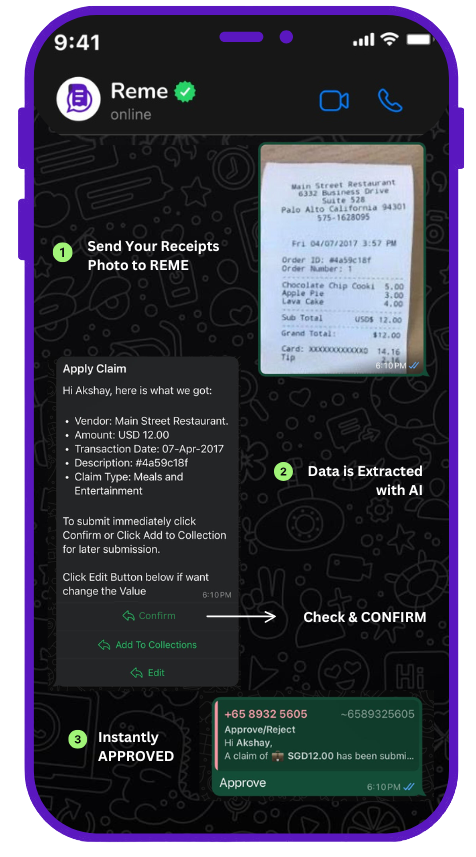
Employees can submit expenses through WhatsApp, making it easy to upload receipts immediately after a purchase without switching between multiple applications. This helps reduce missing receipts and encourages timely submissions.
For managers, automated approval workflows ensure claims are routed to the right approvers without relying on lengthy email chains or manual follow-ups.
Finance teams benefit from a centralized platform where they can review expenses, monitor policy compliance, maintain audit-ready records, and generate reports that support budgeting and financial planning.
By reducing manual administration and improving visibility, REME enables finance teams to spend less time processing expenses and more time focusing on strategic financial decisions.
Frequently Asked Questions
What is expense management?
Expense management is the process of tracking, reviewing, approving, reimbursing, and analysing business expenses while ensuring they comply with company policies.
Why is expense management important?
Effective expense management helps businesses control spending, improve compliance, accelerate reimbursements, reduce administrative work, and maintain accurate financial records.
What types of expenses are included in expense management?
Common business expenses include travel, accommodation, meals, client entertainment, office supplies, transportation, software subscriptions, training, and other approved business-related purchases.
What is the difference between manual and automated expense management?
Manual expense management relies on spreadsheets, paper receipts, and email approvals, while automated expense management uses software to streamline submissions, approvals, reimbursements, and reporting.
How can expense management software improve efficiency?
Expense management software reduces manual data entry, automates approval workflows, improves policy compliance, speeds up reimbursements, and provides real-time visibility into company spending.
Is expense management only for large businesses?
No. Businesses of all sizes benefit from structured expense management. As organisations grow, having a scalable expense management process becomes increasingly important for maintaining financial control.
Conclusion
Business expenses are an essential part of day-to-day operations, but managing them effectively requires more than simply reimbursing employees. A structured expense management process helps organisations maintain financial control, improve compliance, reduce administrative work, and gain better visibility into company spending.
While manual processes may work for smaller teams, they often become difficult to manage as businesses expand. Automating expense management enables finance teams to process claims faster, reduce errors, strengthen internal controls, and make more informed financial decisions.
Investing in the right expense management solution isn’t just about improving reimbursements, it’s about creating a more efficient, transparent, and scalable financial process that supports long-term business growth.
Ready to simplify expense management?
Discover how REME helps finance teams automate expense submissions, streamline approvals, improve spending visibility, and reduce manual work, all through a platform employees already know and use.
Book a demo today to see how REME can help your business build a faster, smarter expense management process.